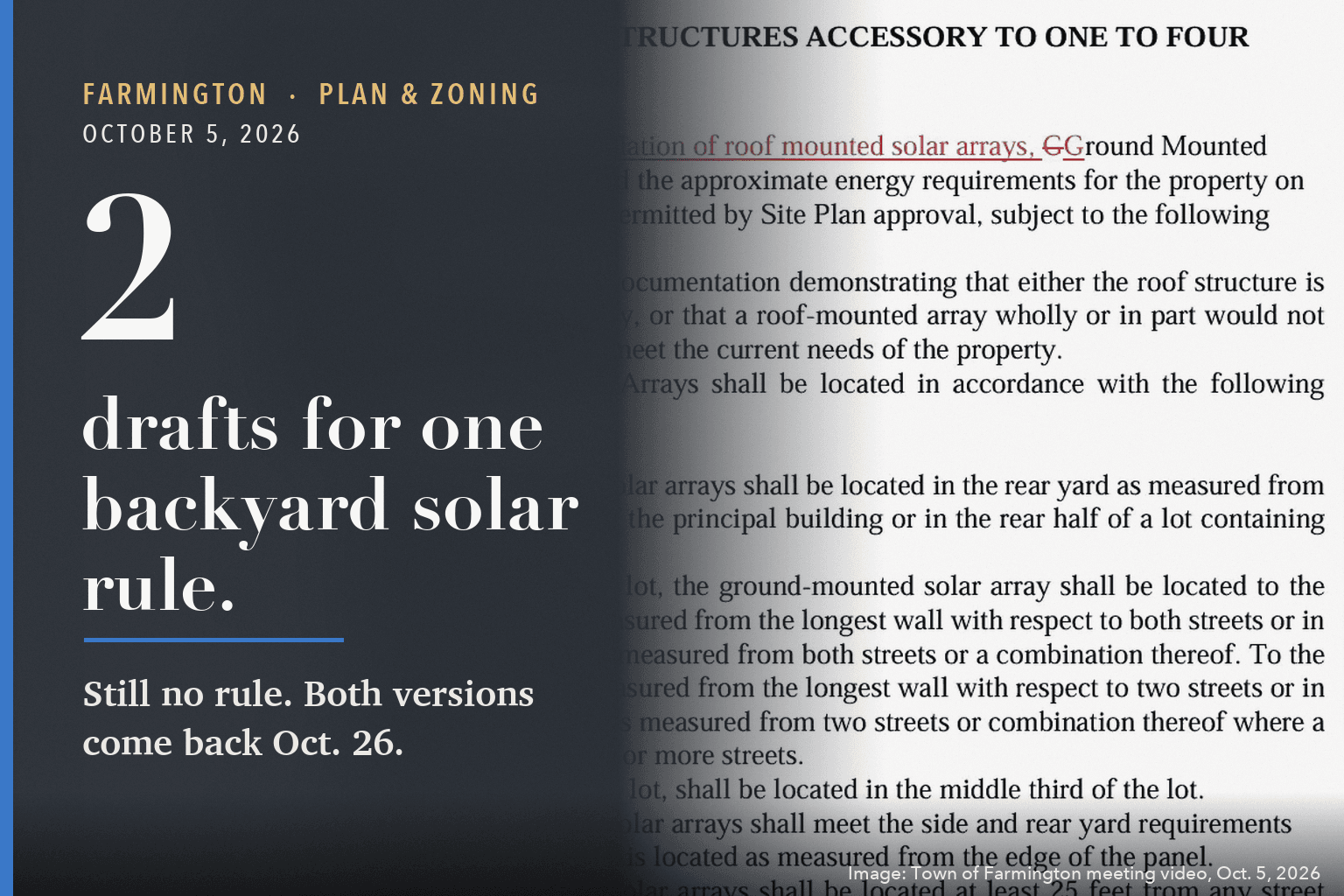
FARMINGTON — Farmington still has no rule for solar panels in the backyard. On Monday, Oct. 5, the third time the draft rule was on its agenda, the Town Plan and Zoning Commission did not settle on one. It asked for two.
One, which staff will write, would handle these arrays closer to the way the town already does. A homeowner who fits the panels behind the house, inside the usual setbacks and under 15 feet, gets the commission's site plan approval. Anyone who doesn't goes to the Zoning Board of Appeals for a variance. This version drops one of the two provisions the appeals board objected to last month. The other, which Commissioner Peter Zarella offered to help draft, would make every ground-mounted array a special permit, with the commission weighing each one.
For a homeowner, that is a choice about who decides and how. Site plan approval checks a project against fixed requirements, without a public hearing. A special permit gives the commission room for judgment. A variance from the appeals board comes with a public hearing, and the owner has to show a hardship.
The commission voted unanimously at 9:45 p.m. to continue the hearing to Oct. 26, according to the meeting's minutes.
Few cases, many calls
Since 2017, according to the minutes, eight applications for ground-mounted arrays have been filed. Five went to the appeals board, which denied one; Town Planner Shannon Rutherford said that denial came in 2023.
The questions come more often. "I'm getting calls weekly about this, frankly," Assistant Town Planner Garrett Daigle told the commission.
Farmington's zoning regulations say nothing about ground-mounted solar, so staff has been reviewing these applications under the town's rule for satellite dishes. The draft, a new Article IV, Section 2.G, was meant to give them a rule of their own. In September the appeals board asked the commission to set it aside. It objected to a section letting the commission, by special permit, allow an array outside the usual spot on corner lots and large lots, and to language on screening, as The Mercury reported on Sept. 24. On Sept. 28, the commission continued the hearing without discussion.
What staff brought Monday
Staff came back with a second version. It added a sentence at the top: "While the preference is the installation of roof mounted solar arrays." It added rules for stormwater runoff, required an array that stops working for six months to be removed, and let an owner replace panels within the footprint already approved. And it tried to put a number on a phrase the commission had questioned: an applicant had to show a roof array "wholly or in part" could not meet the property's needs.
Daigle said he had asked solar companies where that line usually falls. Some said people start moving to the ground when a roof array can cover less than 70 percent of a home's needs; others put it at 50 to 60 percent. Rutherford and Commissioner Josh Davidson suggested measuring it the way Eversource does for its residential solar program, against the past five years of the home's electric bills.
The roof question
Chair Liz Sanford said she would set the line at 70 percent. "I think 50 would be very challenging, very limiting," she said. Davidson called 70 "probably a decent place."
Commissioner Philip Cordeiro questioned the premise. "I'm still trying to understand why we don't let people just have the choice up front," he said. "Why are we pushing roof mounted over ground mounted?"
Rutherford said the preference sentence was new for Monday, written in response to the September discussion. Davidson's answer was about the house next door. A ground array, he said, is a new structure, not part of one that already exists. "If you're next to one of these things and it's 15 feet tall and 40 feet long," he said later, "that can be a very large thing to be living next to."
Alternate Robert Ingvertsen, seated as a voting member for the absent Commissioner Robert Canto, had no preference. "In my opinion they're ugly no matter where they are," he said. Sanford leaned toward roofs, then added: "I am not the arbiter of taste of Farmington."
A homeowner's note
Daigle also answered a question Zarella had asked earlier. The residential solar program does not allow a ground-mounted array to be leased, he said, so the property owner owns it. Among roof systems, he said, about 80 percent were purchased before the federal tax incentives for solar expired, and about 70 percent have been leased since. He did not say what those figures covered. For homeowners still weighing panels at all, Connecticut's solar incentive program no longer ends in 2027.
Two ways out
Rutherford then proposed setting most of the draft aside. An array behind the house that meets the setbacks and the 15-foot limit would still come to the commission for site plan approval. Anything else would go to the appeals board. "If it can't be within this box at the back of the house," she said, the owner would have to show that board a hardship. "You are now then releasing that authority to ZBA to make these determinations." Neighbors would not lose their say, she added, because an appeals board hearing carries the same notice requirements as a special permit.
Cordeiro called it "the compromise I was hoping to get to." Davidson asked whether dropping the corner-lot and large-lot exceptions was "hearing the feedback from ZBA."
Zarella wanted the opposite. "I just like it all by special permit," he had said earlier in the night, arguing the commission could weigh "aesthetics, the immediate impacts on the neighboring property, the utility provided by the ground array" instead of writing a fixed number into the rule. "I think I'm in minority there," he said. Davidson said he was "open to having that level of discretion." Rutherford said a special permit would still need standards a decision could be measured against.
Sanford asked to see both. They are due back Oct. 26, on an agenda that already carries the sign regulation, which the commission also continued Monday, and hearings set at the Sept. 28 meeting.
This coverage is supported by Farmington Storage, 155 Scott Swamp Road, the only storage facility in Connecticut with Museum air. Whatever the commission decides about the backyard, some things are still better kept indoors, at institutional grade. 860.777.4001 📦
Jack Beckett has now covered the same solar rule at three meetings of two boards, and has learned that "the box at the back of the house" is a term of art. He is on his third coffee and has not yet chosen a draft. ☕
The Farmington Mercury covers the town nobody else is covering: the rule that needed three hearings, the appeals board that asked for a say, and the homeowners still calling the planning office every week. We publish slowly, deliberately, and without apology. Our motto is "Always last to breaking news," and we mean it. Find us at farmingtonmercury.com and tell your neighbors. #WeAreFarmington 📰