Your web address is what customers type to reach your website. It can be tempting to pick one packed with search words, hoping they lift you in Google. Google says it adjusts for that. Its plainer advice: pick the name that is best for your business, because people will use it to find you.
A quick check. Search Google for your business by name and read the name printed above your own website in the results. Google calls it the site name and builds it automatically from your home page and from mentions of your site around the web. If it isn’t the name on your sign, start with the home page. Google asks for a unique, accurate name, written the same way everywhere on the home page. It says a generic one such as “Best Dentists In Iowa” is unlikely to be picked. Your Google listing, the box with your details that comes up when someone searches for your shop, has the same rule: its name should match your storefront and website.
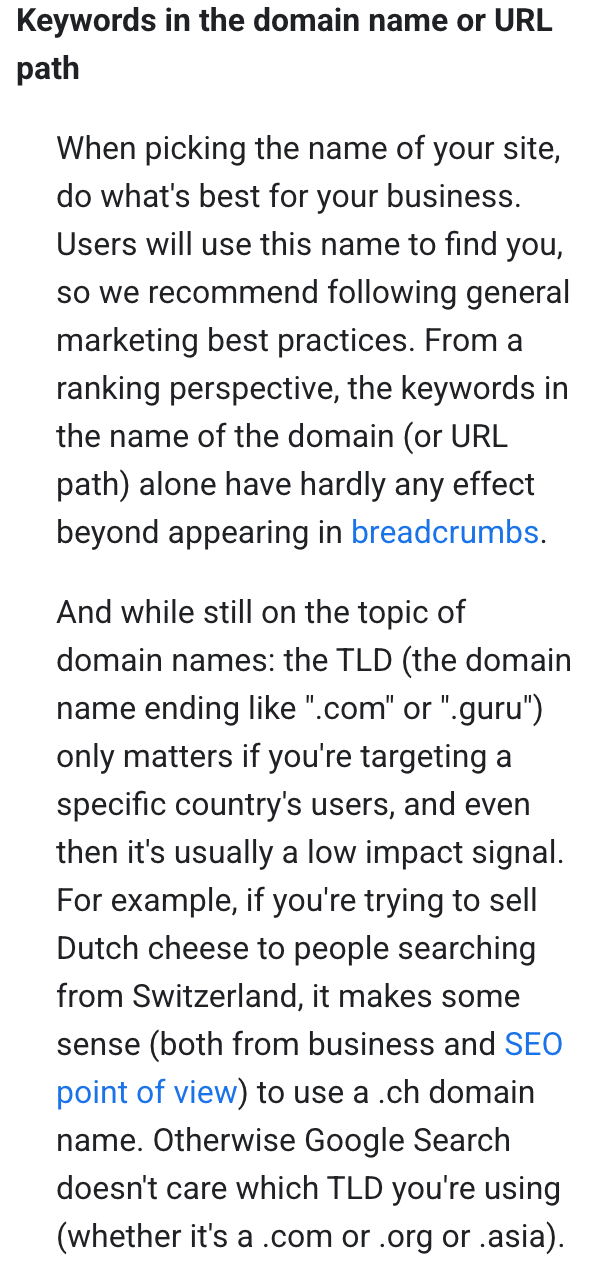
What search words in the address do. Google counts the words in a web address as one of many factors in deciding whether a site fits a search. But it has a check, which it calls the exact match domain system, that keeps it from giving too much credit to addresses built to match particular searches. Its example is an address spelled best-places-to-eat-lunch. Google’s beginner’s guide says such words on their own “have hardly any effect beyond appearing in breadcrumbs,” meaning the address words Google may print as a trail on a result. No Google page we read sets a separate rule for a town name, so Farmington or Unionville in the address is, in our reading, just another search word.
The ending after the dot, such as .com or .org, matters only if you are aiming at customers in another country, and even then it’s usually a weak signal. Otherwise, Google says, “Google Search doesn’t care which TLD you’re using,” TLD being its term for that ending.
Our own view, and not a Google rule: an address that already works isn’t worth giving up for one with a keyword in it. We found no search reason to switch in the Google pages we read.
If you do move. Google warns that where you show up in search may bounce around for a while, and that most pages of a small to medium site can take a few weeks to move over. Google’s way:
- One change at a time. Move to the new address first and change the design afterward.
- Set up redirects, which automatically send visitors from each old page to its new one. Google’s guide on site moves says to keep them “generally at least 1 year.”
- Once the redirects work, report the move with the Change of Address tool, a form that tells Google your site has a new address. It is in Search Console, Google’s free report for site owners, covered in No. 19.
- Keep paying for the old address for at least a year, as Search Console’s help page recommends, so nobody else can buy it and misuse it. No. 22, on who should register and renew a web address, covers that account.
The owner chooses the name and checks it. The forwarding and the filing belong to whoever runs the site. Hand them this: If we change addresses, forward each old page to its match, keep the forwarding a year or more, and file the move in Search Console.
The Standard: Pick an address customers will remember, not one stuffed with search words. If you change it, Google’s “Site Moves and Migrations” guide says to keep the old one forwarding for at least a year.
Source: Google Search Central, on SEO basics, ranking systems, site names and site moves; Search Console Help and Business Profile Help. All read Sept. 25, 2026.
This coverage is supported by Farmington Storage, 155 Scott Swamp Road, the only storage facility in Connecticut with Museum air. A web address customers remember is worth more than a clever one, and so is a storage place they can find. 860.777.4001 📦
Jack Beckett has covered Farmington long enough to know that people still call it the old name, whatever the sign says. He is on his second coffee. ☕
The Farmington Mercury covers the town: Town Council and the land use boards, the police log, the schools, elections, and the businesses in Farmington and Unionville. Our motto is “Always last to breaking news,” and nobody has ever accused us of breaking it. Find us at farmingtonmercury.com and tell a neighbor. 📰