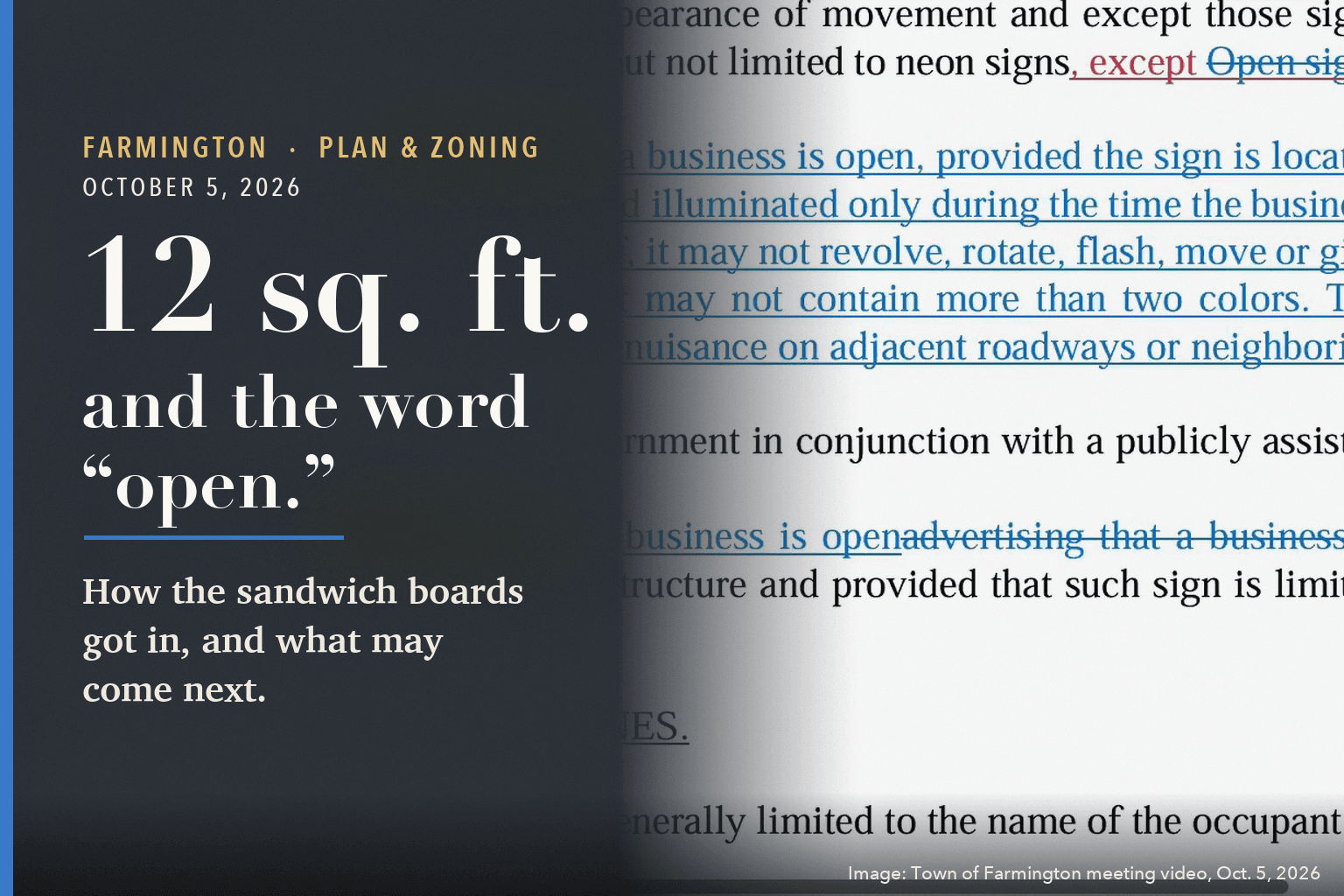
FARMINGTON — When a Farmington business wants a permanent sign out front, the Town Plan and Zoning Commission asks, in Commissioner Josh Davidson's words, about "their lighting and the fonts and the size." A sign saying the business is open, up to 12 square feet, needs no review at all. On Monday, Oct. 5, Davidson asked his colleagues whether that exemption should still cover the sandwich boards he had been noticing along Farmington Avenue, some of them listing products and prices.
The question came up as the commission works through a rewrite of the town's sign regulations, which it has been reviewing since September. It took no vote on the sandwich boards. Staff will bring back language on Oct. 26.
"I paid a lot of attention over the last two weeks," Davidson said, to "the myriad of signs that are out there."
Flags, then A-frames
Town Planner Shannon Rutherford traced the A-frames to a reading of that exemption about a decade ago. She said a longtime member of the planning office recalls that until roughly eight to 10 years ago, A-frame signs were "very few and far between" in Farmington, and the town steered businesses toward "the cute little flag signs that say open on them."
"That was really what Farmington wanted," she said, "the cute little flags and quaint."
Then, by her account, a business pushed back and asked for an A-frame. Read as written, the rule allowed it, staff at the time agreed, and "now we have more A-frame signs in town," Rutherford said. Some of them, she said, were donated by soft-drink and beer companies and carry those brands on the frame.
Today, Assistant Town Planner Garrett Daigle said, the office tells a business it may have one such sign, no more than 12 square feet, and that it should come inside when the business is closed "to the best of your ability." The 12 square feet is per face, Rutherford said, so a two-sided board can carry 24. Staff would rather see an A-frame than "a plastic sign on the two metal stakes that our office constantly is going around picking up," Daigle said.
What Davidson saw
Davidson described what he found, mostly along Farmington Avenue. Keno and lottery signs outside gas stations. A board advertising a specific product at a specific price. A nursery's movable-letter sign listing plants. Signs on Farmington Avenue for businesses that are not on Farmington Avenue. "So they've turned that into like an advertising corridor de facto for other businesses," he said.
Most sit as close to the road as they can get, he said, often in the public right of way. "I do think they create visual clutter," he said. "I think sometimes they do impede people's views getting in and out of some of these places." Allowing them, he said, "undermines what we accomplish with the other regulations."
The lottery signs are a separate matter. The lottery is a state organization and exempt from the town's sign rules, Daigle said.
What the town can and cannot say
The legal bind came from Rutherford. The town cannot dictate what a business's own sign says about the business, she said. She had asked counsel about "open" signs and directional signs, and the answer, as she described it, was that the town may limit them to the business name and the word "open." What it may not do, she said, is choose among products.
"We can't pick and choose and say, well, it's okay for somebody to advertise plants for $10 a flat, but I don't want the beer and liquor stores to say it's 12 bucks for a six pack," she said. "So we either allow them to advertise product or we don't."
For now, she said, staff's working test is whether a sign blocks a sight line or a sidewalk, and whether it is "clearly saying you know coffee two bucks on Saturdays." Daigle pointed to a sign's shape as safer ground. "You can specify that it has to be an A-frame," he said. "That's not content-based."
Davidson's draft
Davidson offered draft language and said every restriction in it was optional. One portable sign, no larger than 12 square feet and no taller than 4 feet, set back at least 15 feet from the road or sidewalk. It could identify the business and say it is open, and nothing else: no products, no prices, no phone number, website or social media. It would come in when the business closes, could not be lit, and could not carry balloons or streamers. He also suggested moving these signs out of the exempt list and into the section for freestanding signs, which the commission reviews.
Tighter rules would need enforcement and a phase-in, with a letter to every business giving it, as she put it, "six months or whatever" to comply, Rutherford said. And a 15-foot setback would be hard for some businesses in Unionville and in Farmington center, where the property line sits at the back of the sidewalk.
Where the commission landed
Commissioner Philip Cordeiro said the first question was whether to regulate them at all. "Do we need to regulate these? Because we don't tell people what to put on other signs, really."
Commissioner Peter Zarella said he does notice the signs, usually when they tell him something useful, and would rather set standards for the sign's structure than its message. Commissioner David St. Germain said he understood the appeal for a business that is "hard to find," in a strip mall or on a corner. Robert Ingvertsen, an alternate seated as a voting member for the night, said Davidson had "opened my eyes," but worried about businesses that get their signs donated: "I'm just worried about these small businesses and adding an expense to them."
Chair Liz Sanford said she liked the clarity of business name and "open." She preferred A-frames to signs mounted on metal, which she said "get flapped around, especially on Route 4" by passing traffic until no one can read them.
Three smaller pieces of the rewrite were settled Monday. Flags from a "professional organization" stay exempt, but "the flag shall not serve commercial or advertising purposes." The open-sign rules now say "indicating" a business is open. And temporary signs for "a non-commercial charitable, social, governmental, educational, or fundraising event" may go up for 14 days. The hearing on the rewrite was continued, unanimously, to Oct. 26.
According to the minutes, the commission agreed the idea "warrants further review." Davidson will send his language to staff, and staff will compare rules in nearby towns, check the wording against case law and bring a version back on Oct. 26.
This coverage is supported by Farmington Storage, 155 Scott Swamp Road, the only storage facility in Connecticut with Museum air. Some things belong out by the road. The rest is kept indoors, at institutional grade. 860.777.4001 📦
Jack Beckett has covered enough Farmington sign hearings to know that 12 square feet is a lot of square feet. He is on his second coffee, price not advertised. ☕
The Farmington Mercury covers the town nobody else is covering: the sign rule with one sentence too few, the commissioner who spent two weeks studying the signs, and the A-frame that started it all. We publish slowly, deliberately, and without apology. Our motto is "Always last to breaking news," and we mean it. Find us at farmingtonmercury.com and tell your neighbors. #WeAreFarmington 📰