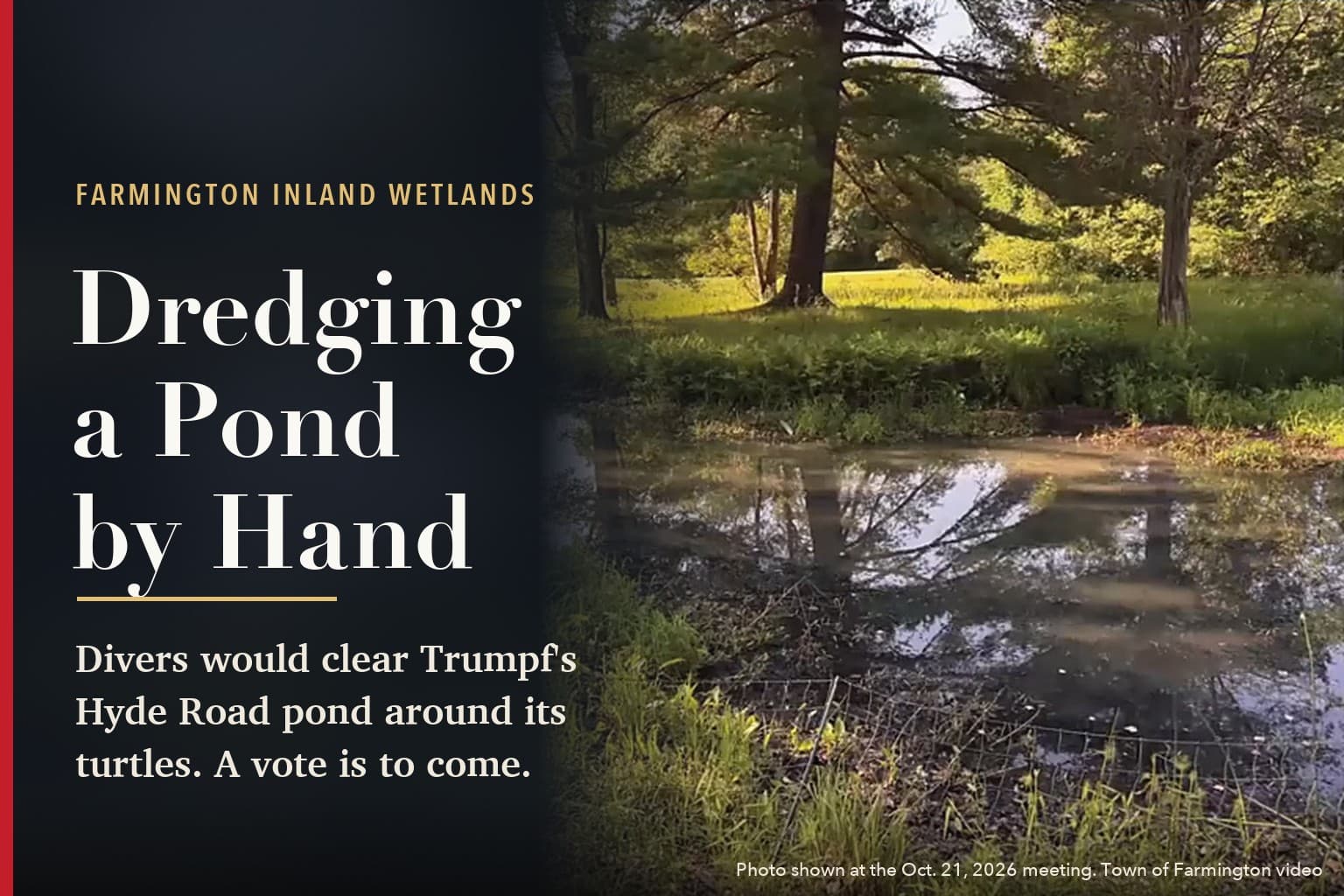
FARMINGTON — The pond behind Trumpf's building on Hyde Road has filled with so much muck that in places it nearly reaches the surface, and the company wants divers to take it out by hand soon, while the turtles that live there are only starting to settle into the mud for the winter.
Divers from the contractor, Pristine Waters of Ridgefield, would brush about 1,600 cubic yards of silt into a 4-inch suction hose with their hands. Anything hard they feel, a rock, a stick or a turtle, gets set aside. The pond loops off Scott Swamp Brook along the property's west edge. A wetland report filed with the town describes Trumpf as "a high-tech company" and says removing the sediment would improve the pond's "water quality and habitat."
None of it is approved yet. On Wednesday, Oct. 21, Farmington's Inland Wetlands Commission accepted Trumpf's application, decided it needs no site walk and found the work not a significant activity, which means no automatic public hearing. The commission is to vote on it at its next meeting.
Martin Brogie, a soil scientist with Martin Brogie, Inc. of Madison, whom Pristine hired for the wetland work, told the commission that while he was at the site, a Trumpf employee found a baby snapping turtle on one of the patios and brought it back to the pond. His written report lists a juvenile snapping turtle and a mature spotted turtle near the pond, and says the soft muck likely gives them a place to spend the winter.
That is why the timing matters. Turtles slow down as the water cools. The report calls that winter dormancy brumation and says it usually begins in mid-to-late October. A turtle disturbed early in that state, it says, can still crawl off and find another spot, and there is soft sediment left in the pond and habitat along the brook for it to go to. "The earlier, the better," Brogie said.
Pristine expects four to six weeks of work in the water and aims to finish that part around the end of the year. The divers can work in freezing water, its representative told the commission, because a hot-water system keeps pumping hot water into their suits.
The sediment would be pumped to bags in a lined, bermed area of the parking lot south of the building, and the water that drains out would go back into the pond. A silt curtain along the pond's west side would limit stirred-up sediment reaching the brook. Once dry, the material would be tested and sent to whatever facility the results call for, Pristine's representative said; a company Trumpf uses handles the removal. Brogie's report leaves open keeping it on the property for landscaping, depending on the lab results.
The commission also accepted a homeowner's plan for a 20-by-8-foot shed at 21 Holmes Circle and decided it needs no site walk. Members said the shed, too, was not a significant activity, and the commission is to vote on it at the same meeting. The owner, Nicholas Nihoul, plans to build it himself on a crushed-stone base just off the bottom of his driveway. The town's wetlands agent, Bruce Cyr, measured about 77 feet from the spot to the wood line where the wetland begins. Nihoul said what he believes is a vernal pool sits farther back on his land. "I do take the wetlands very seriously back there," he said.
This coverage is supported by Farmington Storage, 155 Scott Swamp Road, the only storage facility in Connecticut with Museum air. Your things stay exactly where you left them all winter, and nobody has to go in after them in a wetsuit. 860.777.4001 📦
Jack Beckett has covered Farmington's wetlands commission long enough to read a consultant's turtle report for fun. He learned the word "brumation" from it. Second coffee. ☕
The Farmington Mercury covers the town nobody else is covering: the pond behind the factory, the shed at the bottom of the driveway, the police log somebody had to type up. We publish slowly, deliberately and without apology. Our motto is "Always last to breaking news," and we stand behind it. Find us at farmingtonmercury.com and tell your neighbors. #WeAreFarmington 📰