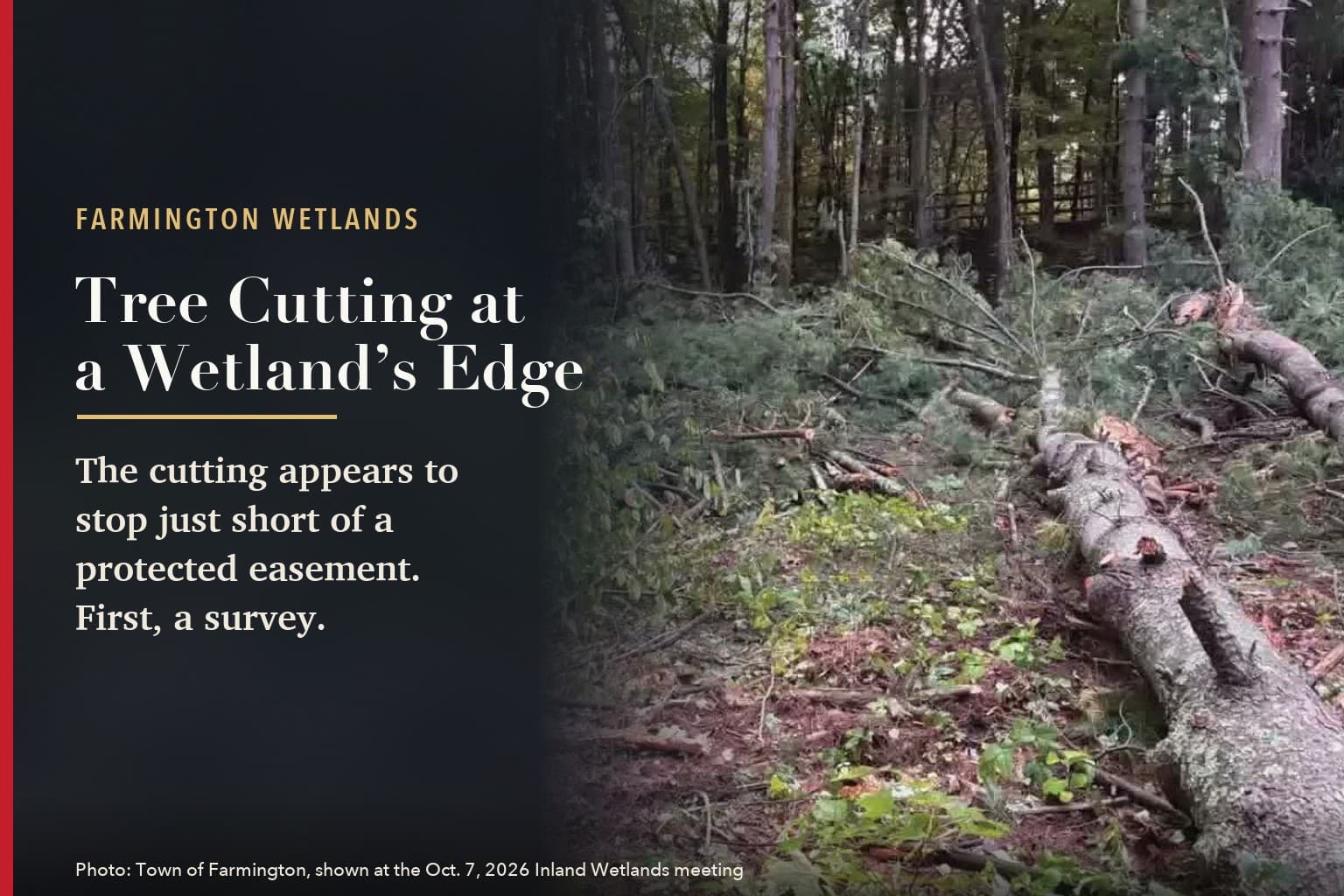
FARMINGTON — An anonymous call on Sept. 29 reported clearing near a wetland at 243 Brickyard Road. When Farmington's wetlands agent got there around 4 p.m., a tree company was still cutting, and most of the trees it had come for were already down.
Bruce Cyr, the town's senior assistant town planner and its conservation and wetlands agent, told the crew to stop. He said it could take down two more, one with a big notch in it and one stripped of its branches, because they were safety hazards; the foreman told him the crew was nearly done anyway. Cyr counted eight large trees he could see, though brush on the ground made it hard to see more, and a commissioner said a couple more were down between the house and the neighbor's, which Cyr said he had not noticed. Most, Cyr thought, were white pines. The town then issued a cease-and-desist order, and on Oct. 7 the owner came before the Inland Wetlands Commission to answer it.
The commission took no formal vote. Polled by the chairman, members agreed to walk the property, and several said the conservation easement that protects the wetland beside the house should be surveyed and marked first.
A line from 1983
The question is whether the cutting crossed into that easement. So far, the answer is probably not, but only barely.
The only maps of the easement Cyr has are two 1983 plans from when the house was built. They show the easement wrapping a wetland, with a spot labeled as a pond that has since filled in with sediment, or may always have been swampy; Cyr said he could not tell which. A town storm drain from Brickyard Road empties into that wetland.
Working from the plans with a tape measure, Cyr found that the farthest stump appeared to be just outside the easement. A steep bank drops from the cleared ground to the old pond, and he believes it marks the line. But the measurement was not definitive either way, he said. It was "so close."
Being outside the easement does not put the work outside the commission's reach. The commission regulates "everything within 150 feet of that wetland," Fox was told at the meeting. "That pretty much takes up your whole property."
The owner's account
The owner, Evan Fox, who said he took over the house's mortgage in 2013, told the commission that a major flood in 2024 caused "irreparable damage," and the house was redone from the subfloor up, work finished about four months ago. During the repairs, he said, his insurer required that trees encroaching on the house come down, and the arborist told him many trees on the property were dead or dying. His property manager hired the tree company.
Going to the town first, Fox said, "did not happen through my manager." He said he wants to sell the house, was there "to rectify the situation" and would do no more cutting along the line.
Not every member was sure about the trees. One commissioner said some trees on the other side were dead, "but those don't look dead to me," then added, "It's hard to say."
What happens now
Until the site walk, members agreed to limited work under Cyr's direction: the cut branches and trunks can be removed and the stumps may be cut flush with the ground. One commissioner raised no concern with seeding the bare soil with quick-germinating rye or something similar. New topsoil will probably have to wait for the survey, one commissioner said. Cyr will meet Fox and his contractor on the property to confirm what comes out. Members also did not object to cutting a large branch hanging over the house, already marked with a pink ribbon.
Once the easement is marked, Cyr said, the town's blue medallions will go along it, so a buyer can see where it runs.
The longer question is what restoration, if any, the commission will require for the cleared ground. One commissioner said the easement itself would have to be "protected and restored." The work outside it, as Fox described it, is "normal use and enjoyment of residential property," the commissioner said, adding that the commission likely has "more leeway" there. Another speaker said the area had been wooded and that "we do need some kind of a buffer," leaning against topsoil and lawn running down to the easement's edge. Fox said the lawn would extend only about another 15 feet, with no grass planted on the ridge above the old pond and the slope beyond the lawn left wild.
A replacement fence between Fox and his neighbor will wait for the site walk, too.
The commission has worked through similar cases this year. In April it approved a three-year restoration plan at 24 Somersby Way, and in July it approved a restoration plan at 114 West Avon Road, where a homeowner had dug a pond in a wetland.
No date is set for the walk. First, Fox has to hire a surveyor to find a line drawn in 1983.
This coverage is supported by Farmington Storage, 155 Scott Swamp Road, the only storage facility in Connecticut with Museum air. A line on a 1983 map can take a surveyor to find. The address above takes only a phone call. 860.777.4001 📦
Jack Beckett has covered Farmington's Inland Wetlands Commission long enough to have opinions about conservation easements. He keeps them to himself. He is on his second coffee. ☕
The Farmington Mercury covers the town nobody else is covering: the wetlands hearing about a cleared backyard, the police log that is technically public record but that you'd never find unless someone typed it up, the zoning vote that decides what gets built on your street. We publish slowly, deliberately and without apology. Our motto is "Always last to breaking news," and we stand behind it. Find us at farmingtonmercury.com and tell your neighbors. 📰